
Public Funds, Professional Failure: The NIE Grade 6 English Literature Textbook Controversy
The National Institute of Education (NIE) recently released its new Grade 6 English Literature module as part of Sri Lanka’s ongoing education reform process. Introduced under the language of modernisation and quality improvement, the textbook now stands exposed as an example of professional failure at multiple levels—writing, reviewing, and institutional oversight.
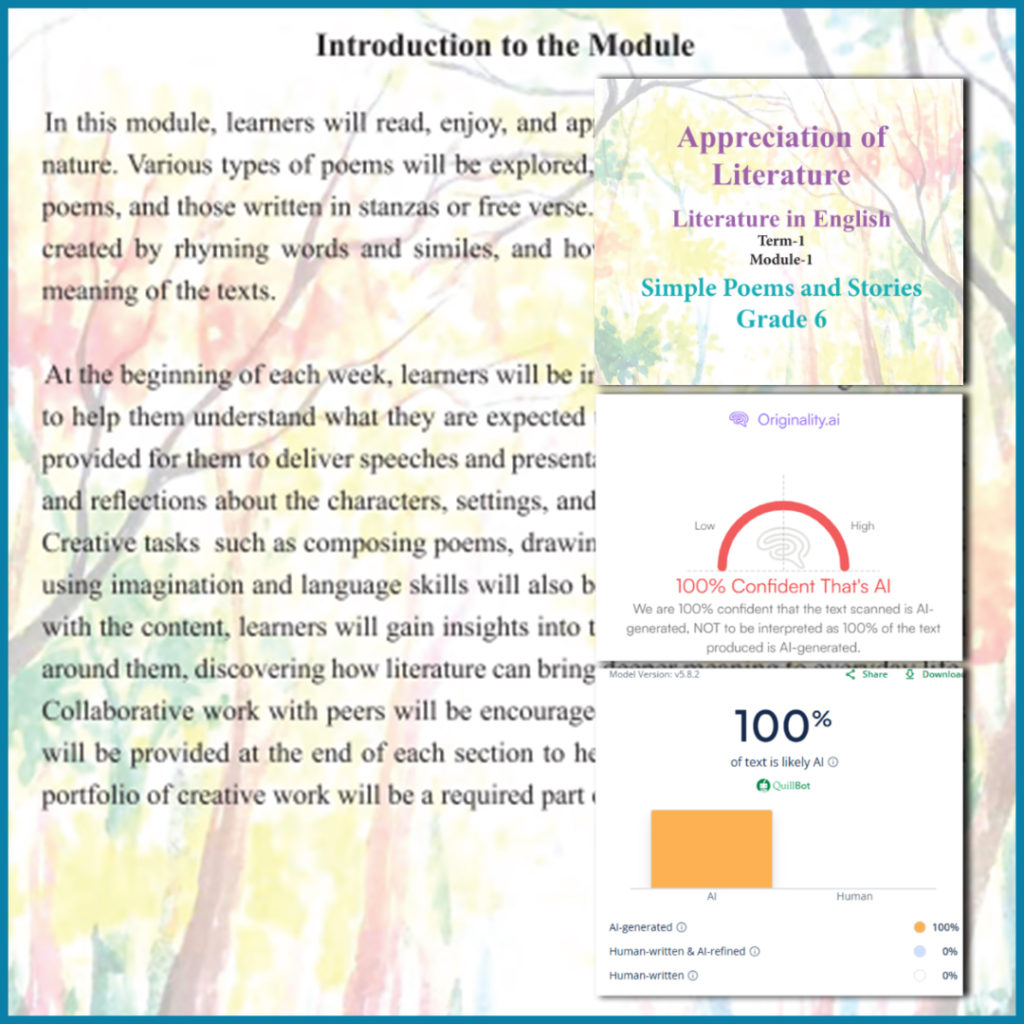
It has now been established that substantial portions of the module, including the entire introductory section, are generated using artificial intelligence. Independent analyses by educators familiar with AI-detection methods indicate a near-total reliance on machine-generated prose. The language is generic, repetitive, and devoid of local educational or cultural grounding—features unmistakably associated with AI output.
That such material appears in a national textbook is indefensible. That it passed through multiple layers of paid professional scrutiny is alarming.
Writers Who Did Not Write
The textbook lists a ten-member panel of writers consisting of Regional English Support Centre (RESC) officials and government school teachers. These individuals were appointed specifically for their expertise and were paid with public funds to produce original academic content.
Instead of writing, they appear to have delegated the core intellectual labour to AI.
This is not a minor lapse or a matter of stylistic assistance. The wholesale use of AI to produce foundational sections of a textbook reflects a lack of effort, a disregard for professional responsibility, and a failure to meet even the most basic expectations of curriculum authorship. When ten professionals submit work that a machine can be identified as having produced, the question is unavoidable: what exactly were they paid to do?
The introduction of a literature textbook is meant to demonstrate voice, critical framing, and pedagogical purpose. The introduction in this module demonstrates none of these. It reads not as the product of experienced educators, but as algorithmic filler—submitted, accepted, and published without shame.
Reviewers Who Failed at the Most Basic Task
Equally culpable is the review panel. The textbook was vetted by three reviewers: two university lecturers and a senior government school teacher. Their role was not symbolic. It was to ensure academic quality, originality, and ethical integrity.
They failed.
The fact that an entirely AI-generated introduction escaped their notice—or was allowed to pass—raises serious doubts about their competence and diligence. This failure is particularly stark given the hypocrisy it exposes. The same university lecturers routinely penalise students for using AI in assignments. Marks are deducted, warnings are issued, and students are lectured on academic honesty.
Yet when AI-generated content appeared in a government textbook they reviewed, those standards vanished.
This double standard severely undermines the credibility of university assessment practices and calls into question the moral authority of the review panel. If AI-generated work is unacceptable for students, it cannot be acceptable for publicly funded professionals producing national curricula.
A System That Rewards Titles, Not Competence
This incident exposes a deeper institutional problem: the apparent reliance on titles and positions rather than demonstrated competence. Panels are appointed, names are listed, payments are made—but meaningful intellectual engagement appears to be absent.
Curriculum development has been reduced to a procedural exercise. Writing panels submit. Review panels approve. Institutions publish. Accountability disappears somewhere in between.
Public Money, Zero Accountability
This textbook was produced using public funds. Taxpayers did not pay for algorithm-generated prose, nor did they pay for reviewers who failed to review. They paid for professional expertise—and did not receive it.
The NIE and the Ministry of Education must be held accountable. A transparent inquiry into the development and approval of this textbook is not optional. The extent of AI use must be publicly disclosed, responsibility must be assigned, and corrective action must be taken. Clear and enforceable national guidelines on the ethical use of AI in curriculum development are urgently required.
Rushed Reform, Predictable Failure
Finally, it is impossible to ignore the role of haste. This textbook bears all the signs of a rushed product—assembled quickly to meet reform deadlines rather than developed carefully to serve students. In the rush to claim progress, essential processes such as thoughtful writing, redrafting, and rigorous review were evidently sacrificed.
Education reform cannot be rushed without consequence. When speed replaces scholarship and deadlines replace diligence, the outcome is predictable: textbooks written by machines, approved by inattentive panels, and imposed on students as “reform.”
Sri Lanka’s children deserve better. Education reform demands integrity, competence, and time. What this textbook reveals is a system that delivered none of the three.