
Eighteen Professionals, One Credits Page, and a Systemic Failure in Sri Lanka’s Education Reform
As Sri Lanka prepares to implement its revised national curriculum in 2026, a systemic failure in textbook production has come to light, raising urgent questions about the competence and accountability of those entrusted with shaping the nation’s education. The subject of scrutiny is a Grade 6 English Literature textbook, Appreciation of Literature, whose credits section—supposedly a straightforward acknowledgement of sources—is shockingly flawed.
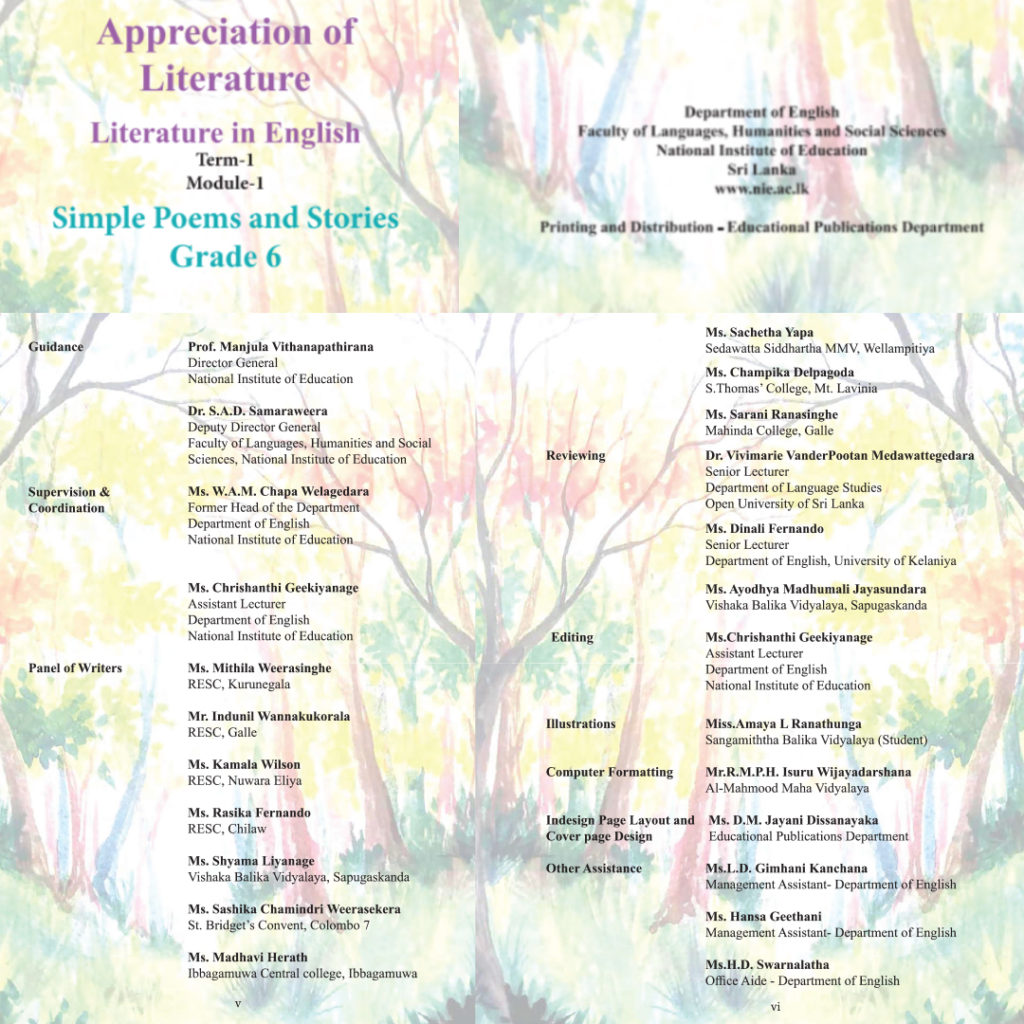
What has emerged is more than editorial negligence: it is a failure of an entire institutional chain, involving 18 professionals across writing, editing, revision, supervision, coordination, and guidance
A Catalogue of Responsibility
The textbook’s development involved:
4 representatives from Regional English Support Centres, and 6 government school teachers as writers
2 senior university lecturers and 1 government school teacher as reviewers (Open University of Sri Lanka and University of Kelaniya), one of whom is known for delivering workshops on proper citation practices to university students
5 Additional editors, advisors, supervisors, and coordinators from the National Institute of Education
This was a team with experience, authority, and specialised knowledge. Yet the credits page reads like an unedited draft, with authors, publishers, URLs, and numbers jumbled together, showing no adherence to publishing, academic, or legal standards.
Academic Authority Ignored Basic Principles
The involvement of university lecturers who teach citation methodology adds a layer of professional embarrassment. A person who trains students on referencing conventions failing to ensure the same in a state textbook reveals a stunning disconnect between expertise and practice. This is not a simple oversight—it is a dereliction of professional duty.
The Hypocrisy of Academic Authority
Universities routinely penalise students for improper citations. Undergraduates fail courses for far less serious errors than those printed in this textbook. Yet when the same standards are violated by senior academics under the banner of state authority, there appears to be no immediate consequence.
This double standard is corrosive. It teaches students a silent but powerful lesson: rules apply downward, not upward.
If a lecturer who teaches citation practices signs off on a textbook that demonstrably ignores those practices, the credibility of such instruction is severely undermined.
Regional English Support Centres and Teachers: The Guardians Who Failed
Representatives from Regional English Support Centres are meant to ensure quality and pedagogical integrity. The six schoolteachers, as writers, were responsible for crafting age-appropriate, academically sound material. Together, these ten professionals should have acted as a robust first line of defence. Instead, no one flagged or corrected the chaotic credits page.
This is systemic negligence: an entire oversight chain allowed a textbook that models poor academic ethics to reach the printing stage.
Legal and Ethical Exposure
The credits section references HarperCollins publications, NCERT content from India, and images from commercial websites like Vecteezy and WallpapersWide. Reproducing these materials without proper permissions could constitute copyright infringement, exposing the State to legal liability. Even if permissions exist, the haphazard presentation undermines transparency and accountability.
The Hidden Lessons Being Taught
Textbooks are more than instructional tools—they are moral and ethical models for students. This literature textbook implicitly teaches:
Proper attribution is negotiable.
Academic authority can disregard standards.
Intellectual property and legal compliance are secondary to expediency.
For students learning the foundations of literature and ethics, this is an educational betrayal.
A Broken Process from the Inside
The failure of 18 professionals to detect and correct such an elementary issue reveals structural weaknesses in textbook production:
Review processes are procedural rather than substantive.
Authority and reputation substitute for rigorous scrutiny
Legal and editorial compliance are treated as secondary
The question now is whether this is an isolated textbook failure or indicative of wider vulnerabilities across multiple subjects and grades.
Questions Demanding Answers
Were the editorial, legal, and copyright checks truly conducted, or were they superficial?
How did university-level citation experts allow such a fundamental lapse?
What role did Regional English Support Centres play, and why did they fail to intervene?
Who ultimately approved the textbook for printing despite these errors?
These questions are critical not just for the credibility of the textbook, but for the integrity of the entire 2026 curriculum reform.
Accountability Cannot Be Deferred
Authority carries responsibility. When 18 professionals collectively fail, the problem is systemic. Immediate corrective measures must include:
Transparent investigation of the revision and approval process
Withdrawal or correction of the flawed edition before nationwide distribution
Review of individual and institutional accountability
Clear guidelines for proper citation, copyright compliance, and AI tool disclosure
A Cautionary Tale for Reform
Sri Lanka’s education reform is intended to prepare students for the future. Yet, when textbooks—the very instruments of that preparation—display basic negligence despite expert oversight, the reform risks being discredited before it begins.
The failure of this textbook is not just an editorial lapse; it is a wake-up call for systemic accountability, rigorous professional standards, and ethical stewardship in public education. Until these lessons are acted upon, the credibility of Sri Lanka’s 2026 curriculum reform remains in question.